Flower Line Art: The Power of Botanical Clipart in Modern Design
In a digital landscape often saturated with complex gradients and heavy textures, there is a distinct power in simplicity. Floral line art and botanical clipart offer a breath of fresh air, providing designers with versatile assets that blend seamlessly into a variety of projects. Whether you are a seasoned graphic designer, a small business owner refining your brand, or a crafter looking for the perfect element, understanding how to leverage these hand-drawn assets is key to creating sophisticated, professional work.
The Visual Character of Hand-Drawn Botanicals
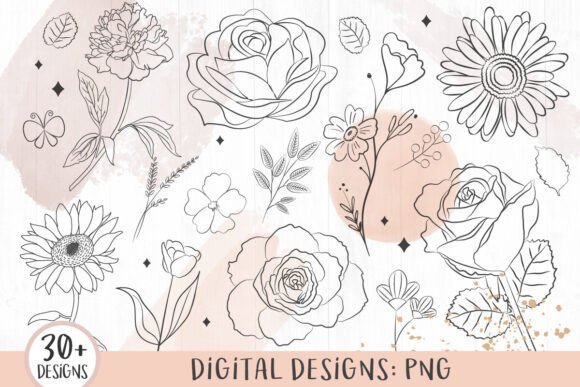
Floral line art is defined by its clean, continuous strokes and monochromatic palette. Unlike photographic elements or dense vector fills, line art relies on negative space to define form. This style conveys a sense of authenticity and organic warmth that digital-only graphics often lack. When you utilize a set of hand-drawn botanical PNGs—featuring everything from delicate roses to bold sunflowers—you are introducing a "human touch" into your layout. This aesthetic appeals to modern typography trends that favor minimalism and earthy elegance. The black and white nature of these assets ensures they act as a neutral canvas, allowing the designer to dictate the mood through background colors and context rather than being locked into a specific color scheme.
Strategic Applications Across Industries
The versatility of floral clipart makes it a staple in the toolkit of creative professionals. However, its application requires strategic thinking to ensure it enhances rather than clutters a design.
- Brand Identity and Logo Design: For businesses in the wellness, beauty, wedding, or organic food sectors, a floral line art logo establishes immediate brand recognition. It signals a commitment to quality and nature. When used in logo design, these elements often serve as framing devices or subtle icons that complement a sans serif font or a script font.
- Editorial and Packaging Design: In publishing, botanical illustrations break up text-heavy pages in magazines and books, providing visual relief. In packaging design, they elevate the perceived value of the product. A simple black line drawing on a kraft paper background creates a rustic, premium feel that appeals to eco-conscious consumers.
- Digital Presence and Web Design: For web design and social media graphics, transparent PNGs are invaluable. They can be layered behind text to create depth or used as dividers between content sections. Because they are high-resolution (typically 300 DPI), they maintain crispness on Retina displays and large monitors.
- Stationery and Printables: The market for printable wall art and modern stationery relies heavily on this style. From wedding invitations to planners, these assets allow for easy customization. Crafters using machines like Cricut or Silhouette also benefit from the clean lines, which are easier for software to trace and cut accurately.
Integrating Floral Assets with Typography
One of the most critical aspects of using floral clipart is ensuring it harmonizes with your chosen typeface. The goal is to create a cohesive visual hierarchy. Floral line art tends to have a distinct personality—often organic and slightly irregular—which pairs exceptionally well with specific font categories.
For instance, the delicate nature of line art balances the weight of a serif font like Garamond or Times New Roman, creating a classic, editorial look. Conversely, pairing botanical doodles with a clean, geometric sans serif font like Helvetica or Montserrat offers a modern, high-contrast aesthetic that works well for tech startups with a human touch or minimalist lifestyle brands. Avoid pairing these assets with overly ornate display fonts or chaotic handwritten fonts, as this can result in visual noise where the illustration competes with the text for attention.
Practical Guidance for Designers and Entrepreneurs
When selecting a premium font or design asset pack, such as a collection of 34 botanical elements, it is vital to evaluate the technical specifications alongside the aesthetic appeal.
- Evaluate Resolution and Format: Always ensure the assets are high-resolution (300 DPI) and provided with transparent backgrounds. This allows for seamless integration into packaging design and print media without the hassle of removing white boxes or dealing with pixelation.
- Check Commercial Licensing: For entrepreneurs and small business owners, understanding the license is non-negotiable. You must verify if the clipart allows for commercial use, such as on products for sale or in client work. A "commercial font" or asset license protects your business legally.
- Test for Versatility: Before committing to a design direction, test the assets in various contexts. Place the floral elements on dark backgrounds to see how they pop, and layer them over busy textures to ensure they remain legible. This testing phase is crucial for maintaining brand consistency across different platforms.
- Consider the "Coloring" Potential: Black and white line art is uniquely versatile because it can be treated as a coloring page. You can use clipping masks in software like Photoshop or Illustrator to fill specific parts of the illustration with brand colors or textures, effectively turning a generic asset into a custom brand element.
Elevating Your Creative Projects
Ultimately, the goal of using flower line art is to enhance the storytelling of your project. Whether you are designing a minimalist wedding invite or a complex editorial spread, these botanical elements serve as visual anchors. They guide the viewer's eye, soften the edges of hard geometric layouts, and inject a sense of life into static designs.
By treating floral clipart not just as decoration, but as a fundamental component of your visual hierarchy, you can significantly improve audience engagement. It transforms a standard layout into something memorable and tactile. As you move forward with your next project—be it a new logo design, a series of social media posts, or a line of merchandise—consider how the timeless appeal of hand-drawn botanicals can bridge the gap between digital precision and organic warmth. It is this balance that often defines the most successful and enduring design work.